What Is Smart Money — and What It Is Not
Smart money refers to institutional investors — hedge funds, pension funds, corporate insiders, endowments, and commercial hedgers — who deploy capital at scale with professional research teams, proprietary data, and regulatory obligations to disclose their positions. Collectively, institutional investors manage over $70 trillion globally, dwarfing the retail trading universe. Their mandatory filings with the SEC and CFTC create a public record of where this capital is positioned.
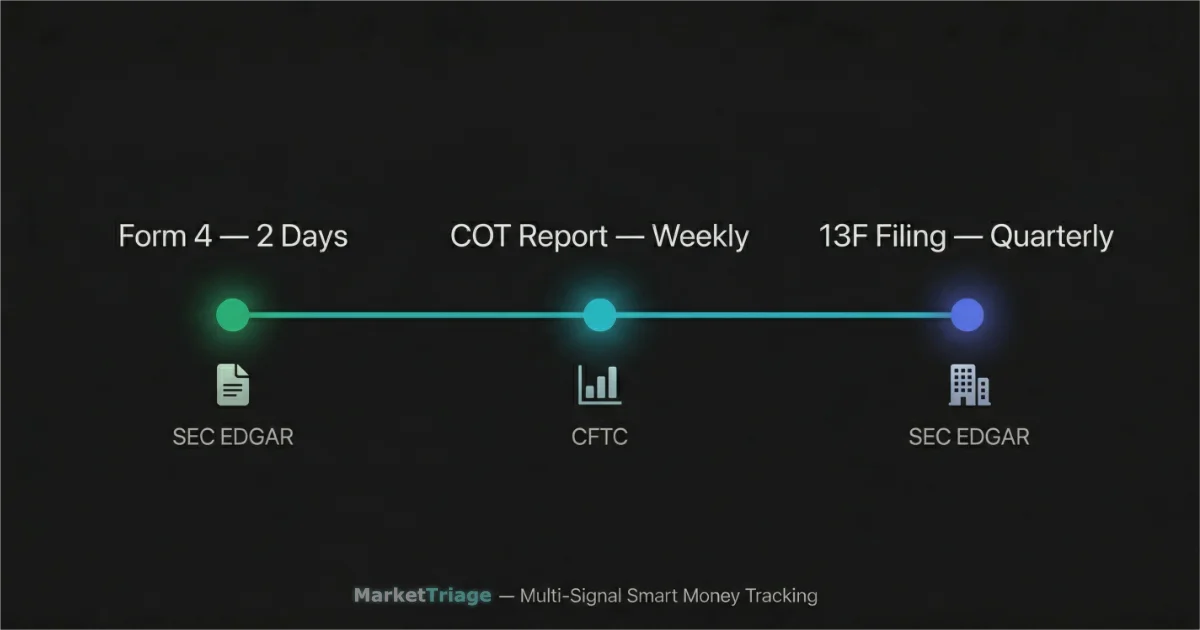
Three regulatory filing systems form the data layer of smart money tracking: SEC Form 13F (quarterly hedge fund holdings), SEC Form 4 (insider transactions within 2 business days), and the CFTC Commitment of Traders report (weekly futures positioning). Each captures a different slice of institutional behaviour on a different cadence. Combined, they produce a public record of disclosed positions that no single source delivers on its own.
Think of it as the difference between diagnosing a patient by reading their medical chart (lab results, imaging, vital signs) versus guessing the diagnosis by how they walk into the room. This guide focuses on reading the chart — the regulatory filings that institutional investors are required by law to produce. (If you have encountered the phrase "smart money" in a chart-pattern day-trading context — order blocks, fair value gaps, BOS, CHoCH — see Smart Money Positioning vs Smart Money Concepts (SMC) below for the disambiguation.)
Smart Money Positioning vs Smart Money Concepts (SMC)
The phrase "smart money" has two distinct meanings in trading communities, and conflating them is the most common source of confusion. Smart Money Concepts (SMC) — popularized by Michael J. Huddleston (ICT, "Inner Circle Trader") — is a chart-pattern day-trading methodology. It uses constructs like order blocks, fair value gaps, break-of-structure (BOS), change-of-character (CHoCH), and liquidity sweeps to infer institutional behavior from raw price action. SMC traders read candles to guess where banks and funds are operating.
Smart money positioning — the framework MarketTriage uses — is something different. It reads actual institutional positioning data from regulatory filings: SEC Form 13F (quarterly hedge fund holdings), SEC Form 4 (insider transactions within 2 business days), and the CFTC Commitment of Traders report (weekly futures positioning). The data is direct — not inferred from candles, but pulled from the disclosures institutions are legally required to make.
Both approaches are legitimate; they answer different questions. SMC asks "where on this chart is institutional liquidity?". Positioning analysis asks "which institutions own this asset, and is their net position growing or shrinking?" The two can complement each other — a Form 4 cluster confirming a price reaction at a higher-timeframe order block is stronger than either signal alone — but the underlying data sources, time horizons, and interpretive frameworks are different. This guide is about positioning data. If a tutorial uses the words order block, FVG, or liquidity sweep, it is teaching SMC, not regulatory-filing analysis.
The Four-Pillar MarketTriage Smart Money Stack
MarketTriage's smart money signal stack has four pillars — three primary data sources from regulatory filings, plus the synthesis layer that combines them.
| Pillar | Source | Update Cadence | What It Tells You |
|---|---|---|---|
| Insider buying | SEC EDGAR Form 4 | Within 2 business days of trade | Executives putting their own money on the line. A cluster of 3+ unique insiders within 30 days is a high-conviction discretionary signal. |
| 13F whale holdings | SEC EDGAR Form 13F | Quarterly, 45-day filing lag | Where 21 tracked institutions (Berkshire, Bridgewater, Renaissance, Pershing Square, Third Point and others) are positioned in equities ≥ $200M positions. |
| COT commercials | CFTC weekly release | Every Friday 3:30 PM ET (data from prior Tuesday) | Net positioning of producers, users, and refiners across 11 futures markets. Multi-year z-score extremes mark sentiment inflection points. |
| Conviction score | Aggregated MarketTriage signal | Per-asset, recomputed on every cron | Combines the three pillars above with technical structure and macro context into a 0–100 score with 6-state regime classification. |
The three filing pillars feed individual insider, whale, and COT signals; the conviction layer is what surfaces them on the MarketTriage dashboard with regime context.
Three Public Data Sources That Reveal Institutional Positioning
Three government-mandated filing systems, each operating on a different timeline and capturing a different dimension of institutional behavior, form the foundation of smart money tracking. SEC Form 4 provides near-real-time insider conviction (2 business days). CFTC COT reports provide weekly futures positioning. SEC Form 13F provides quarterly hedge fund allocations. Together, they create a multi-speed picture of where institutional money is flowing.
Who: Corporate officers, directors, 10%+ shareholders
What: Individual stock purchases and sales with exact prices and dates
Fastest institutional signal. Insiders act on operational knowledge unavailable to outside investors.
Who: Commercials, hedge funds, managed money in futures markets
What: Net long/short positioning across commodities, indices, currencies
Captures macro sentiment. Commercial hedger positioning reflects physical market supply/demand knowledge.
Who: Institutional managers with $100M+ in US equities (~5,000 filers)
What: Every long US equity position: stock name, number of shares, and dollar value
Shows where the largest capital pools are deployed. Convergence across independent funds is historically significant.
The Timeline Advantage
Each data source is like a different vital sign in a medical checkup. Form 4 is the heart rate — fast, real-time, captures immediate changes. COT is the weekly blood panel — shows systemic positioning trends. 13F is the quarterly MRI — deep structural view of where capital is deployed. No single vital sign tells the full story. Combined, they provide a diagnostic picture no individual data source can match.
SEC Form 13F: Quarterly Hedge Fund Holdings
Every institutional investment manager with $100 million or more in US equity assets must file Form 13F with the SEC within 45 calendar days of each quarter-end. The filing lists every long US equity position — identified by unique security ID — along with share count and market value as of the snapshot date. Approximately 5,000 firms file each quarter, and every filing is free on SEC EDGAR.
The 45-day lag means 13F data is stale for day traders but perfectly cadenced for position traders operating on weekly-to-monthly timeframes. The signal is not the precise entry price — it is the multi-quarter accumulation pattern. When Warren Buffett's Berkshire Hathaway ($350 billion portfolio), Stanley Druckenmiller's Duquesne Family Office ($13 billion), and Bill Ackman's Pershing Square ($18 billion) independently increase their positions in the same stock over two consecutive quarters, that convergence reflects independent analytical conclusions from well-resourced investment teams.
What 13F does not show: short positions, cash holdings, foreign securities, most derivatives, and cryptocurrency. Options are reported but without directional context — a put could be a bearish bet or a protective hedge. For a comprehensive breakdown, see How to Track Hedge Fund Holdings via 13F Filings.
SEC Form 4: Insider Trades Within 2 Business Days
Corporate officers, directors, and shareholders owning 10% or more of a company must file SEC Form 4 within two business days of buying or selling company stock. This makes Form 4 the fastest institutional signal available — orders of magnitude quicker than the quarterly 13F. Filings appear on SEC EDGAR within hours of submission.
The academic evidence is substantial. Research by Lakonishok and Lee (Review of Financial Studies, 2001) found that firms with heavy insider buying outperformed firms with heavy insider selling by roughly 7.8% over the following 12 months (about 4.8% after adjusting for size and value). The signal strengthens with clusters — when three or more unique insiders purchase open-market shares of the same company within a short window (typically 10 days), multiple people with deep operational knowledge are independently committing personal capital. This is not a chart pattern. These are real people risking real money based on information about the company they operate.
Not all insider transactions carry equal weight. Pre-scheduled selling programs (called 10b5-1 plans) execute regardless of the insider's current view — they are noise. Open-market purchases (transaction code P on Form 4) represent discretionary capital commitment and are the focus of smart money tracking. For the full framework, see Insider Trading Signals: SEC Form 4 Guide.
CFTC COT Report: Weekly Futures Positioning
The Commodity Futures Trading Commission (CFTC) collects positioning data at the close of every Tuesday and publishes the Commitment of Traders report every Friday at 3:30 PM Eastern Time. The report covers US futures markets — commodities (gold, oil, copper), indices (S&P 500, Nasdaq), and currencies — showing how three categories of traders are positioned: Commercials (hedgers with physical market exposure), Large Speculators (hedge funds trading for directional profit), and Small Speculators (retail traders).
Commercials are often called the "smart money" of futures markets because their positioning reflects fundamental knowledge of physical supply and demand. A gold miner hedging production at $2,400/oz is acting on real-world cost and demand data. When commercial hedger positioning reaches historical extremes — meaning their current position is far outside the normal range for the past 3 years — it historically precedes major turning points. Larry Williams built his approach around COT data and documented the methodology in Trade Stocks and Commodities with the Insiders. He famously turned $10,000 into roughly $1.1M (the widely-cited 11,376% figure) in the 1987 Robbins World Cup Trading Championship — a single-year contest result, not a peer-reviewed long-horizon track record.
COT data complements 13F and Form 4 because it covers an entirely different asset universe (futures vs. equities) on a faster timeline (weekly vs. quarterly). For the full methodology and z-score framework, see COT Report Explained: Beginner's Guide.
What Happens When Smart Money Signals Converge
The highest-conviction smart money signal is not any single data source — it is convergence across multiple independent sources. When hedge funds are accumulating a stock (13F), company insiders are buying with personal money (Form 4), and COT positioning confirms the directional thesis — three completely independent information streams are pointing the same direction. This multi-source agreement historically carries more weight than any individual signal.
Convergence Levels
- Single source — one data point (e.g., one hedge fund bought). Worth noting, but inconclusive. May reflect rebalancing or redemption flows.
- Two sources aligned — meaningful pattern. Hedge fund accumulation (13F) confirmed by insider buying (Form 4) means outside investors and inside operators independently agree.
- Three sources aligned — highest conviction. 13F + Form 4 + COT all confirming the same direction. Three independent data streams, three different timelines, three different methodologies, one conclusion.
The whale + insider alignment is particularly powerful because it combines two completely independent groups: external hedge fund managers (who see the stock from a capital allocation perspective) and internal company executives (who see the business from an operational perspective). When both groups independently commit capital to the same position, the signal reflects a convergence of outside financial analysis and inside operational knowledge. MarketTriage flags this combination as the highest-conviction smart money signal, connecting it to the 6-state regime classification to assess whether the broader market structure supports the signal.
This convergence thesis is applied in a publicly tracked, real-money portfolio: the “Trendstarke Qualitätsaktien” wikifolio (symbol WFMTRIAGE0) holds trend-leading stocks that are simultaneously backed by institutional 13F and insider Form 4 activity, and trims equity exposure when that backing fades. It is run in German and primarily accessible to investors in Europe, and is referenced here as an applied illustration of signal convergence — not an offer, solicitation, or recommendation to invest. A continuously updated paper-trading track record documents the same method on simulated capital.
Common Mistakes When Tracking Institutional Activity
The accessibility of institutional data creates a false sense of simplicity. The filings are public, the names are famous, and the numbers are clear. But the most common analytical errors occur not from misreading the data, but from applying it without context.
Mistake 1: Confusing SMC with Filing-Based Tracking
Smart Money Concepts (SMC) — chart-based day-trading uses order blocks, fair value gaps, and liquidity sweeps to infer institutional activity from price patterns. It has no connection to actual SEC or CFTC filings. The phrase 'smart money' means different things in different trading communities. This guide is about regulatory filings, not chart patterns.
Mistake 2: Treating Individual Trades as Signals
Single 13F entry — data point, not signal. Funds buy stocks for dozens of reasons: rebalancing, tax optimization, client mandate changes, macro hedging. The signal comes from convergence — multiple independent institutions reaching the same conclusion. One Berkshire Hathaway 13F line without corroboration from Form 4 insiders or COT positioning is noise, not intelligence.
Mistake 3: Ignoring the Filing Timeline
Form 4 = T+2 days, COT = T+3 days, 13F = T+45 days. Treating all three as 'current' data is like comparing yesterday's temperature, last week's weather forecast, and last season's climate data as if they all describe today. Each source has a specific temporal window — matching the data to the decision timeframe is essential.
Mistake 4: Chasing Headlines on Filing Day
13F filing day — 'Buffett bought X' moves stocks 3-5% within hours, and by the next session that information is fully priced. The edge in institutional tracking does not come from reacting to headlines. It comes from systematic monitoring of position changes across multiple filers and multiple quarters — detecting accumulation trends that a single headline cannot reveal.
Mistake 5: Using Quarterly Data for Intraday Decisions
13F (45-day lag) and COT (3-day lag) are not suited for day trading or scalping. Smart money tracking through SEC and CFTC regulatory filings is designed for position traders operating on weekly-to-monthly timeframes — the cadence where institutional capital deployment actually moves markets.
Smart Money Tracking Tools Compared
Several platforms provide access to institutional data, each with a different scope. Some focus on a single data source (13F only, or insider only). Others combine multiple sources but present them as separate tabs without synthesis. The fundamental question is whether the tool shows institutional data in isolation or connects it across sources to detect convergence patterns automatically.
| Tool | Focus | Free | Signals | Multi-Signal |
|---|---|---|---|---|
| WhaleWisdom | 13F filings, 10K+ filers | Yes (2-year) | 13F only | No |
| OpenInsider | SEC Form 4 insider data | Yes | Insider only | No |
| TIKR | Holdings + fundamentals | Yes | 13F + insider | No |
| Barchart | COT charts + data | Yes | COT only | No |
| SentimenTrader | Sentiment + flow models | No ($) | Proprietary | Partial |
| MarketTriage | 21 curated institutions + signals | Yes (beta) | COT + insider + 13F + regime | Yes |
WhaleWisdom and TIKR offer the broadest 13F coverage. OpenInsider is the most comprehensive free insider trading tracker. Barchart provides the best free COT charts. SentimenTrader combines proprietary sentiment models with COT data behind a paywall. MarketTriage tracks fewer filers (21 curated whales) but is the only platform that combines all four signal layers — COT positioning, insider Form 4 clusters, whale 13F convergence, and a 6-state regime classification — into a single dashboard with automated convergence detection. See the four-signal position trading system for how to apply these layers in a weekly workflow.
Free Beta Access
Track where institutional money is moving — explained in plain English.
MarketTriage reads SEC and CFTC filings so you don't have to. See where 21 major hedge funds, corporate insiders, and futures traders are positioned — all in one dashboard.
- Pulse Check— Track actual institutional flow data, not Twitter hype.
- Sentiment Extremes— Know exactly when the market has reached peak “Hopium” or panic.
- Beta Status— Lifetime discount on future features
Frequently Asked Questions
What is smart money in trading?
Smart money refers to institutional investors — hedge funds, pension funds, corporate insiders, and commercial hedgers — who manage large pools of capital with professional research teams. Their trades are tracked through regulatory filings: SEC Form 13F (quarterly hedge fund holdings), Form 4 (insider transactions within 2 days), and CFTC COT reports (weekly futures positioning).
How do you track smart money in stocks?
Three public data sources reveal institutional positioning. SEC Form 13F shows quarterly hedge fund holdings ($100M+ managers). SEC Form 4 shows insider buying and selling within 2 business days. CFTC COT reports show weekly futures positioning by trader category. All three are free on government websites (SEC EDGAR and CFTC.gov).
What are the best smart money indicators?
The most reliable smart money indicators are based on regulatory filings, not price patterns. 13F convergence (multiple hedge funds independently buying the same stock), insider buying clusters (3+ executives purchasing within 10 days), and COT extreme positioning (current positions far outside the 3-year normal range) all reflect real capital commitments rather than chart interpretations.
Is smart money always right?
No. Individual institutional trades have mixed track records. The signal value comes from convergence — when multiple independent institutions reach the same conclusion. A single hedge fund buying a stock is a data point. Three hedge funds and two company insiders buying the same stock independently is a pattern with historical significance.
What is the difference between smart money and retail money?
Smart money (institutional investors) manages over $70 trillion globally, employs professional research teams, and files mandatory regulatory disclosures. Retail money (individual investors) manages personal accounts without filing requirements. The key distinction is not intelligence — it is resources, scale, and transparency via mandatory SEC and CFTC filings.
Can you track smart money for free?
Yes. All underlying data is free. SEC EDGAR provides 13F filings and Form 4 insider transactions at no cost. CFTC publishes COT reports every Friday on cftc.gov. The challenge is not access — it is synthesis. Reading thousands of filings manually is impractical. Tools like MarketTriage automate scanning, pattern detection, and multi-signal synthesis.
How does combining smart money signals improve accuracy?
Each data source captures a different dimension of institutional behavior on a different timeline. COT shows weekly futures positioning, Form 4 shows near-real-time insider conviction, and 13F shows quarterly hedge fund allocation. When all three align on the same stock, the probability of a meaningful move is historically higher than any single signal alone.
What is the Smart Money Flow Index?
The Smart Money Flow Index (SMFI) tracks market performance at the open versus the close, based on the theory that retail traders dominate the open while institutional traders trade near the close. It is a technical indicator — separate from the regulatory filing-based approach (13F, Form 4, COT) that tracks actual disclosed positions.
How often is smart money data updated?
It depends on the source. SEC Form 4 insider trades: within 2 business days. CFTC COT reports: weekly (every Friday at 3:30 PM ET, reflecting Tuesday positions). SEC 13F hedge fund filings: quarterly (45-day lag). Each operates on a different timeline, which is why combining them provides a more complete picture than any single source.
What is the difference between smart money concepts (SMC) and smart money tracking?
Smart Money Concepts (SMC) is a chart-based day trading methodology focused on order blocks, fair value gaps, and liquidity sweeps — it infers institutional activity from price patterns. Smart money tracking uses actual regulatory filings (13F, Form 4, COT) to observe real disclosed positions. One interprets charts; the other reads mandatory government disclosures.
How do executive insider trading public disclosures generate market signals?
Executive insider trading public disclosures are SEC Form 4 filings — submitted within 2 business days of a transaction. When 3 or more executives independently buy open-market shares of the same company within 10 days, that cluster is a research-grade signal. Lakonishok and Lee (Review of Financial Studies, 2001) found firms with heavy insider buying outperformed firms with heavy insider selling by roughly 7.8% over 12 months.
What is smart money?
Smart money is capital deployed by institutional investors — hedge funds, mutual funds, corporate insiders, and commercial hedgers — whose moves are disclosed via SEC 13F, SEC Form 4, and CFTC COT reports. These participants run research teams and dedicated capital pools, and their positions are a public regulatory record.
Is Smart Money Concepts (SMC) the same as smart money positioning?
No. Smart Money Concepts (SMC) is a chart-pattern day-trading method popularised by ICT (Inner Circle Trader) — order blocks, fair value gaps, break-of-structure, liquidity sweeps. It infers institutional behaviour from price action. Smart money positioning reads regulatory filings (13F, Form 4, COT) directly. Both are legitimate, but use different data.
Where does smart money positioning data come from?
Three free public sources: SEC EDGAR (13F quarterly hedge fund holdings + Form 4 insider transactions) and the CFTC Commitment of Traders weekly futures report. All raw filings are free at the source. MarketTriage's value-add is synthesis, hysteresis-aware tracking, and a 0–100 conviction score across 212+ assets — not paywalled access to the underlying data.
Why follow smart money?
Institutional capital — roughly $70 trillion globally — creates sustained directional pressure when it accumulates or distributes. Insider buying has documented historical outperformance of about 7.8% over 12 months — roughly 4.8% after risk adjustment (Lakonishok & Lee, Review of Financial Studies, 2001). The strongest application is convergence: when multiple smart-money sources agree on the same asset, the signal is materially stronger.
Can retail traders actually use this data?
Yes, with caveats. 13F is lagged 45 days, Form 4 within 2 business days, COT lagged 3 days — none are timing tools for intraday entries. They work as a conviction layer over a chart setup, or as the primary lens for position-trading horizons of weeks to months.
Continue Learning
Live Insider Tracker
Live SEC Form 4 cluster tracker — $500k+ purchases, C-suite filter, regime overlay
live data readPosition Trading System
How to synthesise COT, 13F, Form 4, and regime signals into a multi-month thesis
14 min read13F Whale Tracking
How to track hedge fund holdings and detect convergence across 21 institutional filers
12 min readInsider Trading Signals
When 3+ executives buy their own stock within 10 days — what the patterns reveal
12 min readSee MarketTriage Plans →
For informational purposes only. Historical patterns are not indicative of future results. This is not financial advice. MarketTriage provides observational analysis of publicly available regulatory data and does not offer directional trade recommendations. Sources: SEC EDGAR (13F) · SEC EDGAR (Form 4) · CFTC COT Reports.