What Is Position Trading — and Why Regime Classification Matters
Position trading is an active trading strategy that holds a single trade for weeks to months — occasionally longer — to capture a multi-month trend. It sits between swing trading (days to weeks) and buy-and-hold investing (years to decades). Unlike buy-and-hold investors, position traders can go long or short, scale positions in and out, and exit when the underlying thesis breaks rather than waiting for retirement.
The central challenge of position trading is not picking a direction. It is knowing when the market structure supports holding for months and when it does not. A stock in a confirmed Stage 2 uptrend with institutional accumulation is one environment. The same stock in late-cycle distribution with credit spreads widening is a completely different environment. The price looks similar on the chart. The risk is not.
This is the reason modern position trading relies on market regime classification. A 6-state model — STABLE, CLEARANCE, OBSERVATION, ELEVATED, CRITICAL, and BREAKDOWN — replaces the binary bullish/bearish label with a diagnostic vocabulary that maps to the Wyckoff cycle: accumulation, markup, distribution, markdown. Each regime implies a different posture. CLEARANCE is where position traders commit capital. BREAKDOWN is where they do not.
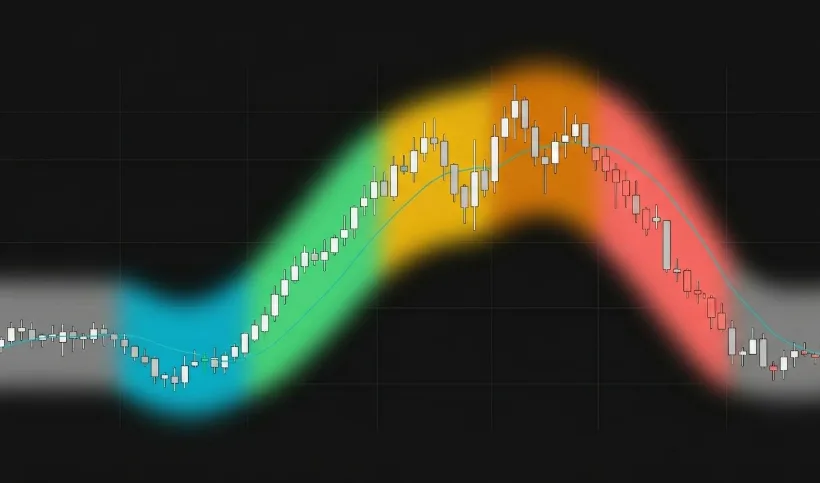
The question for a position trader is never just "is this stock going up?" It is "is the market regime, the institutional positioning, and the technical structure all aligned long enough to justify a multi-month hold?" If any one of those three is missing, the trade is a gamble, not a position.
The Position Trader's Four-Signal Stack
A position trade that only uses one signal — say, a moving average crossover — is brittle. A single data source can lie. Four independent signals that all point the same direction is a thesis. Each of the four sources below fills a specific gap the other three cannot.
| Signal | Source | Cadence | Role |
|---|---|---|---|
| COT Data | CFTC | Weekly (Fri 3:30 PM ET) | Positioning extremes in futures |
| 13F Filings | SEC | Quarterly | Hedge fund holdings + convergence |
| Form 4 Filings | SEC | Within 2 business days of trade | Insider cluster detection |
| Regime Classification | MarketTriage | Daily updates, weekly commit | 6-state structural synthesis |
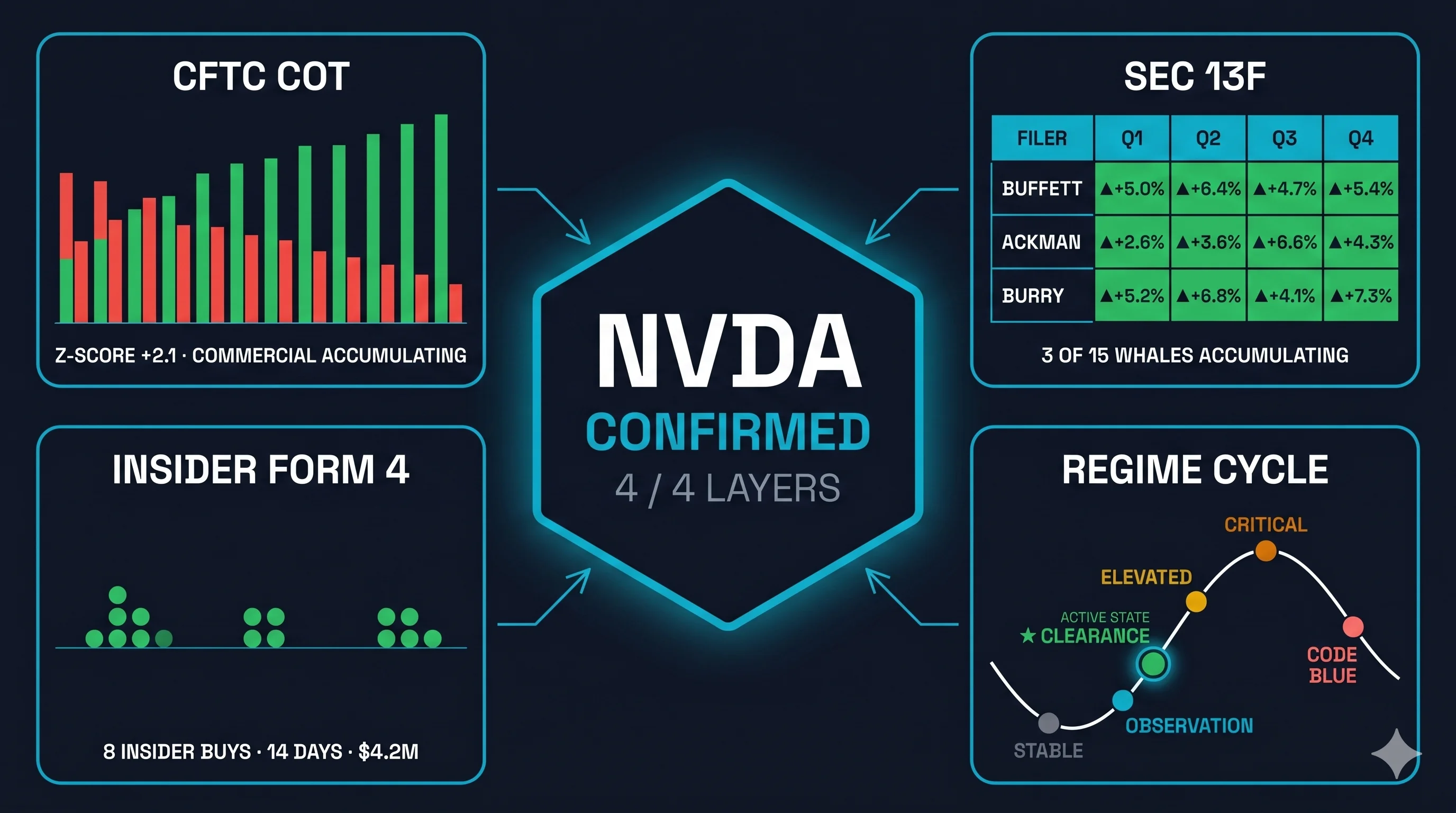
Each signal has a different publication lag: Form 4 comes out within 2 business days, COT within 3, regime classification same-day, and 13F on a 45-day delay. This lag asymmetry is the reason position traders who only watch 13F filings always feel late. The fast signals (Form 4, regime, COT) lead; the slow signal (13F) confirms.
The goal is convergence, not agreement at every moment. A typical high-conviction position trade looks like this: regime transitions to CLEARANCE → COT shows Commercials at a 3-year net long extreme → Form 4 shows a 3-insider cluster buying the same stock within 30 days → 13F confirms two quarters later that Berkshire and Bridgewater both built positions. The first three are actionable in real time. The 13F is the audit trail.
Reading COT Data for Multi-Month Entries
The CFTC Commitment of Traders report splits futures market participants into three groups: Commercials (producers and hedgers — typically considered "smart money" because they have fundamental supply-and-demand knowledge), Large Speculators (hedge funds and managed money trading for directional profit), and Small Speculators. The report publishes every Friday at 3:30 PM Eastern Time, reflecting positions as of the prior Tuesday.
For position traders, the signal is positioning extremes — points where a participant group reaches a 3-year or 5-year high or low relative to its own historical range. Commercials reaching an extreme net long position has historically preceded multi-month rallies. Large Speculators reaching an extreme net long position has historically preceded reversals as the trade becomes crowded. These extremes set up on weekly and monthly timeframes — not intraday.
The markets where COT signals are historically most reliable are precious metals (Gold, Silver), energy (Crude Oil), and agricultural futures (Corn, Wheat, Soybeans). These markets have distinct commercial hedger groups whose positioning reflects real supply-and-demand knowledge. Equity index futures (S&P 500, Nasdaq) and currency pairs (EUR/USD, JPY/USD) carry moderate reliability.
A COT extreme is not an entry signal by itself. It is a bias signal. You still need the price structure to confirm and the regime classification to gate the trade. Position traders who buy gold just because Commercials are net long — without checking regime or technical structure — lose money on the timing, even when the bias is right.
Confirming Entries with 13F and Form 4 Convergence
COT data covers futures. For individual equities, position traders use SEC 13F filings and SEC Form 4 cluster detection instead. These two filings do different jobs.
13F filings are the quarterly portfolio disclosures required of any institutional manager with $100 million or more in US equities. They reveal what hedge funds like Berkshire Hathaway, Bridgewater Associates, Renaissance Technologies, Pershing Square, Scion Asset Management, and Third Point are holding. The value is in convergence: when two or more independent managers increase the same position during the same quarter, it is more meaningful than any one of them acting alone. The drawback is the 45-day reporting lag — by the time you see the filing, the position may already have moved. Michael Burry's Scion Asset Management 13F filings are a textbook example: position changes only become visible 45 days after the quarter ends, but Form 4 clusters and regime transitions can flag the same thesis weeks earlier.
Form 4 filings are the real-time counterpart. Corporate officers, directors, and 10-percent-plus shareholders must disclose purchases and sales of their own company's stock within two business days. A single insider buying means little. A cluster — three or more insiders buying the same stock within 90 days — has historically been one of the strongest signals in equity markets. Position traders weight C-suite buys (CEO, CFO, COO) above director trades and filter routine 10b5-1 planned sales.
Form 4 clusters as real-time confirmation
The convergence pattern that position traders look for on an equity entry is: regime transitions to CLEARANCE or OBSERVATION → Form 4 cluster of 3+ insider buys emerges → 13F of the prior quarter confirms at least one notable fund accumulating. When all three are present, the probability that the move has multi-month legs is materially higher than any one signal alone.
The Weekend Routine (Regime Scan → Watchlist → Entry)
Position trading is a weekly-cadence craft. Watching the tape is unnecessary — the craft rewards a consistent Saturday or Sunday routine that scans, prioritises, and prepares. The routine below runs in 30 to 60 minutes on the MarketTriage dashboard.
Check the overall market regime
Open the dashboard and read the three-column layout. CLEARANCE (green) = confirmed uptrends accepting new positions. OBSERVATION (blue) = developing setups worth watching. CAUTION (orange) = step away or scale out. If the majority of your watchlist has moved to CAUTION, reduce exposure across the board rather than picking individual names.
Read Friday's COT release
The report drops Friday 3:30 PM ET. Over the weekend, look for any asset where Commercials or Large Speculators have hit a 3-year or 5-year extreme. Flag these for deeper review. The weekly cadence matches position-trading cadence; the 3-day lag is irrelevant.
Scan the week's insider clusters
Review any new Form 4 clusters from the prior 5 business days. A cluster of 3+ insiders buying the same stock within 90 days is the signal. Weight C-suite heavier than directors. Filter out scheduled 10b5-1 sales.
Review 13F filings (if in window)
13F filings arrive in waves around February 14, May 15, August 14, and November 14. If you are within a filing window, scan for whale convergence across the 15 tracked funds. Outside those windows, skip this step.
Validate convergence before entering
For each candidate: is the regime supportive? Is COT positioning at an extreme? Is there an insider cluster? Was there 13F accumulation last quarter? High-conviction setups require at least three of the four pointing the same direction. If fewer than three align, the setup is not high-conviction — pass.
Set entry triggers and position sizes
Calculate position size from account equity and stop distance: (account equity × 1%) ÷ (entry − stop) = share count. Place a stop at a level the thesis can survive (below a key moving average, not at a fixed percentage). Record the trade in your journal with the four-signal rationale.
The discipline matters more than the content. The routine's value compounds with consistency — simple and repeated outperforms sophisticated and sporadic in historical backtests. Consistency is the edge.
Regime-Based Exits (When Institutions Unwind)
The most common way position traders give back profits is exiting on emotion rather than on thesis break. A position is still valid as long as the conditions that justified the entry are still present. It is invalid the moment those conditions break. Fixed profit targets are a worse exit signal than thesis-break rules.
For a long position trade, the thesis is broken when any two of the following occur:
- Regime transition. The asset moves from CLEARANCE or OBSERVATION into ELEVATED, CRITICAL, or BREAKDOWN. The structural setup that supported the trade has changed.
- COT flip. Commercials flip from net long to net short in the weekly COT report (for futures positions), or Large Speculators reach a crowded long extreme.
- Insider distribution. Form 4 activity shifts from cluster buying to C-suite selling — particularly when the selling is discretionary (code P or S) and not scheduled (10b5-1).
- 13F unwind. One or more of the previously accumulating funds reduces or exits the position in the next quarterly filing.
Any two of the above is a scale-out: sell half, raise the stop on the remainder. Three is a full exit. This is why MarketTriage's regime alerts trigger first — they are the earliest warning. The COT flip and Form 4 distribution usually follow within a week or two; the 13F confirms one quarter later.
Scaling out is not the same as giving back profits. Position traders who scale out on partial thesis-breaks preserve more capital than traders who hold until the regime collapses. The goal is not to catch the absolute top. The goal is to exit before the downside dominates the trade.
Position Sizing and Stops for Multi-Month Holds
Position sizing for multi-month holds is not the same as swing-trade sizing. A position you intend to hold for 12 to 26 weeks must tolerate normal drawdowns that a 2-week swing trade would not survive. The discipline is simple: size small enough that normal volatility does not stop you out.
The standard framework is the 1-percent rule — risk no more than 1 percent of account equity per trade. Some traders use 2 percent during CLEARANCE regimes and reduce to 0.5 percent during ELEVATED. The formula: (account equity × risk percent) ÷ (entry price − stop price) = share count.
Stop placement for position trades should be structural, not percentage-based. A position held for 20 weeks will have periods where the stock trades 10 to 15 percent below entry without the thesis breaking. Setting a stop at a fixed 5 percent below entry will route you out of otherwise profitable trades. Better anchors: below the rising 50-day or 200-day moving average, below a recent swing low, or at a 3-ATR Chandelier Exit level. The position trader's stop is wider than the swing trader's. The per-share risk is larger. The position size is smaller. Expected-value math works out the same.
Regime-aware traders scale down position size as regimes deteriorate. A full 1-percent position in CLEARANCE becomes a 0.5-percent position when the asset transitions to ELEVATED. At CRITICAL or BREAKDOWN, the position is typically already fully exited — the system is designed so new entries are not taken during CAUTION regimes.
Frequently Asked Questions
What is position trading?
Position trading holds a single trade for weeks to months to capture a multi-month trend. Position traders use daily and weekly charts, size positions small enough to survive normal drawdowns, and exit when the underlying thesis breaks rather than at fixed profit targets.
How long do position traders hold a trade?
Typical holding periods are 4 to 26 weeks. The exit is governed by thesis, not calendar: a position is held as long as regime, institutional positioning, and technical structure still support it. A regime transition from CLEARANCE to ELEVATED is the common trigger to scale out.
What signals do position traders use?
Position traders stack four institutional signals. CFTC Commitment of Traders data shows futures positioning. SEC 13F filings reveal quarterly hedge fund holdings. SEC Form 4 captures insider trades within two business days. Market regime classification synthesises these into six structural states. When signals converge, conviction is high.
How do you use COT data for position trading?
Read the weekly COT report for positioning extremes — points where Commercials or Large Speculators hit a 3-year or 5-year historical peak. Extreme Commercial net long has historically preceded multi-month rallies; extreme Speculator net long has preceded reversals. Published Fridays 3:30 PM ET, reflecting the prior Tuesday — well-suited for weekly decisions.
What is a position trader's weekly routine?
A weekend routine: (1) check the market regime for every watchlist asset, (2) read Friday's COT release for positioning extremes, (3) scan new SEC Form 4 insider clusters, (4) review 13F filings in window, (5) validate entries via four-signal convergence. Total time: 30 to 60 minutes.
When should a position trader exit a trade?
Exit when the thesis breaks. Four thesis-breakers for a long trade: (1) regime transitions into ELEVATED, CRITICAL, or BREAKDOWN; (2) Commercials flip net short in COT data; (3) C-suite Form 4 selling replaces insider buying; (4) 13F filers unwind next quarter. Any two breaking is a scale-out; three is a full exit.
Is position trading better than swing trading?
Neither is universally better — they serve different time commitments. Swing trading holds for days to weeks with daily review. Position trading holds for weeks to months with weekly review, producing larger per-trade profits, fewer trades, lower transaction costs, and better tax treatment. It suits traders with day jobs.
What is the best timeframe for position trading?
Position traders operate primarily on the daily and weekly charts. The daily chart is used for entry timing and stop placement; the weekly chart is used to confirm the longer-term trend structure and market regime. Intraday charts are not relevant for position trading — the signal frequency does not match the decision frequency.
How much should a position trader risk per trade?
The standard discipline is 1 to 2 percent of account equity per trade, allowing 10 to 20 consecutive losses without ruin. Position size is calculated from stop distance: (account equity × risk percent) ÷ (entry − stop) = share count. Regime-aware traders reduce size 30 to 50 percent during ELEVATED or CRITICAL regimes.
Can you use insider trading data for position trading?
Yes. SEC Form 4 insider-buying clusters — three or more executives or directors buying their own stock within 90 days — have historically preceded multi-month outperformance. Position traders use clusters as entry validation, weighting C-suite buys (CEO, CFO, COO) above director trades. Routine 10b5-1 planned sales should be filtered out as pre-scheduled and uninformative.
Subscribe to weekly position-trading signals
- Pulse Check— Track actual institutional flow data, not Twitter hype.
- Sentiment Extremes— Know exactly when the market has reached peak “Hopium” or panic.
- Beta Status— Lifetime discount on future features
Continue Learning
Live Insider Tracker
Live SEC Form 4 cluster feed — confluence with regime + 13F overlay for the 6-step workflow
live data readSmart Money Tracking
COT + 13F + insider flow combined into one signal view
14 min readMarket Regime Classification
Six structural states that replace simple buy/sell signals
18 min readCOT Report Explained
How institutional futures positioning signals turning points
15 min read13F Filings Explained
Track what the biggest funds are buying and selling
12 min readInsider Trading Signals
How SEC Form 4 cluster buys reveal real-time insider conviction
14 min readSee MarketTriage Plans →
For informational purposes only. Historical patterns are not indicative of future results. This is not financial advice. MarketTriage provides observational analysis of publicly available regulatory data and does not offer directional trade recommendations. Primary data: CFTC.gov · SEC.gov.