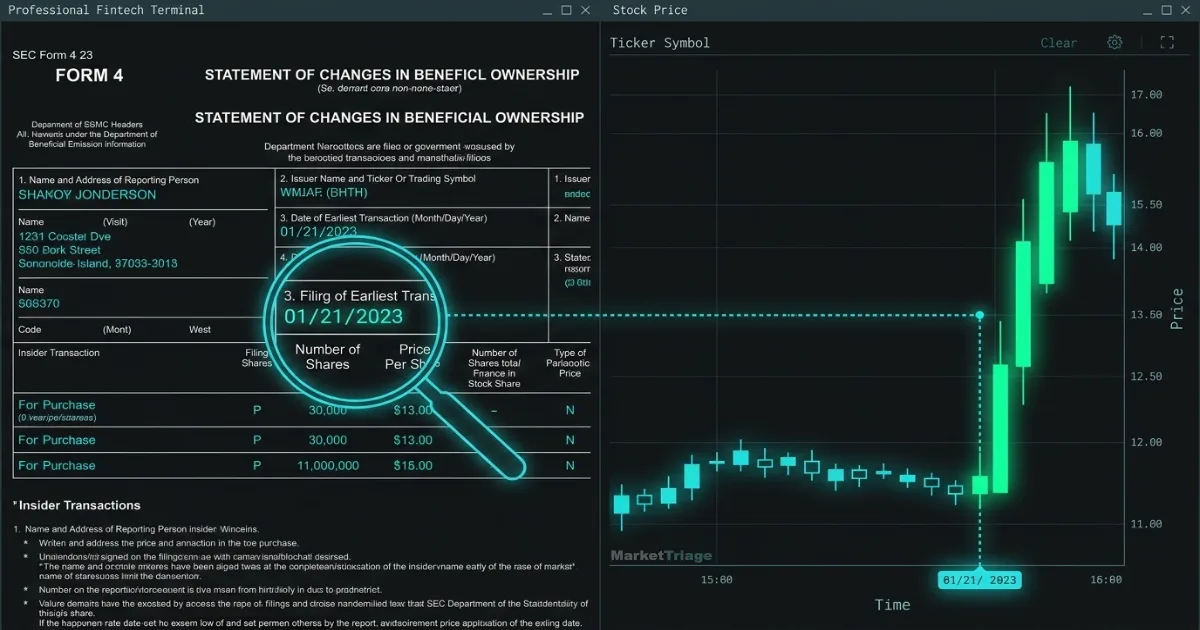
Key Facts: SEC Form 4 Insider Filings
- Legal basis: Section 16(a) of the Securities Exchange Act of 1934
- Filing deadline: Within 2 business days of the transaction
- Where to access: SEC EDGAR (free, public, no registration)
- Who files: Officers, directors, and 10%+ beneficial owners
- Key transaction codes: P = open-market purchase, S = sale, A = grant/award
- Cluster threshold: 3+ unique insiders within a 15-day acute window (60-day backdrop)
- Strongest signal: Whale + insider alignment (13F + Form 4 converging)
What Are Insider Trading Signals?
Insider trading signals are patterns detected in the legally mandated SEC filings of corporate insiders — executives, directors, and shareholders who own more than 10% of a company's stock. Under Section 16(a) of the Securities Exchange Act of 1934, these individuals must disclose every purchase, sale, or transfer of their company's shares by filing SEC Form 4 within two business days. The filings are published on the SEC's EDGAR database and are freely available to anyone.
The logic is straightforward. A CEO who spends $2 million of personal money buying shares on the open market is making a voluntary bet with their own wealth — not exercising options, not receiving a grant, but writing a check. That person has access to quarterly revenue trends, pipeline health, customer retention data, and strategic plans that public investors will not see for weeks or months. When three, four, or five executives at the same company all make similar purchases within a short window, the signal carries substantially more diagnostic weight.
Think of insider filings as a doctor's own health choices. If a cardiologist quietly starts exercising more, adjusting their diet, and taking specific supplements, they may know something about heart health that their patients have not yet been told. Insider buying is the corporate equivalent — the people with the deepest operational knowledge are putting their own money on the line.
How to Read an SEC Form 4 Filing
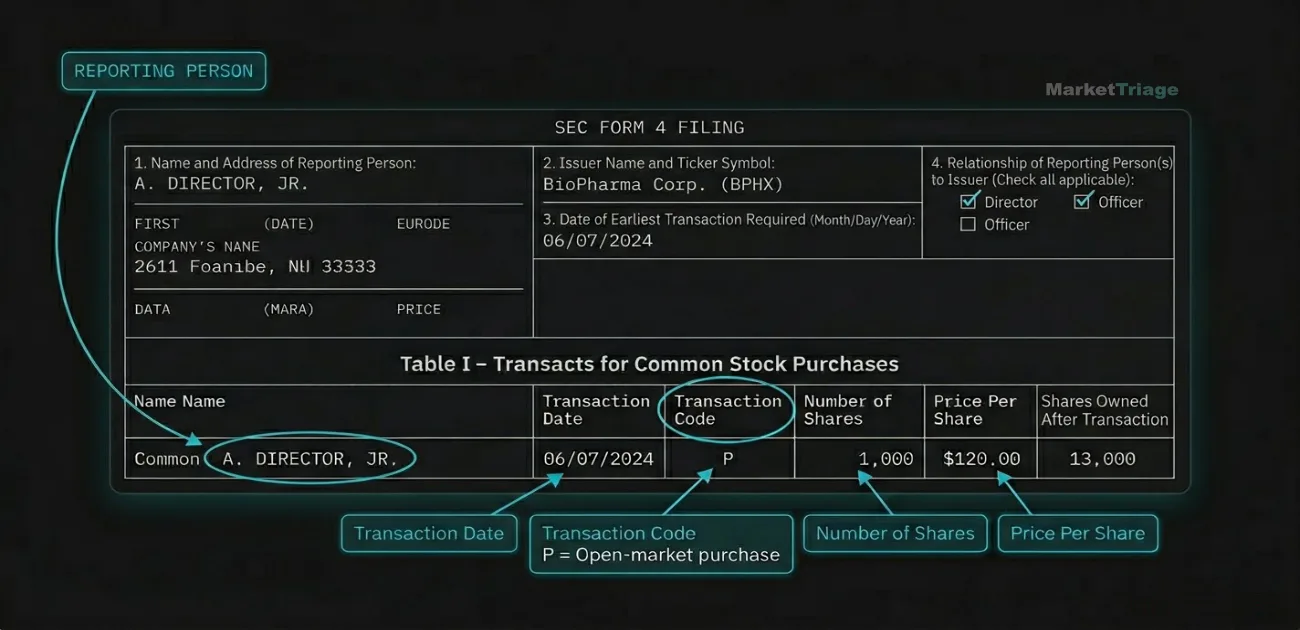
SEC Form 4 is a one-page disclosure document filed with the SEC's EDGAR system. Not all filings are created equal — the transaction code is the single most important field for distinguishing signal from noise.
| Field | What It Contains | Why It Matters |
|---|---|---|
| Reporting Person | Name and relationship to the company (CEO, CFO, Director, 10% Owner) | Identifies who made the trade and their level of operational access |
| Transaction Date | The exact date the shares were bought or sold | Enables cluster detection — multiple insiders buying within days of each other |
| Transaction Code | P = Open-market purchase, S = Open-market sale, A = Award/grant, M = Option exercise | Only code P (open-market purchases) represents voluntary capital commitment with personal funds |
| Shares Transacted | Number of shares bought or sold in this transaction | Combined with price, reveals dollar conviction — a $2M purchase carries different weight than a $10K one |
| Price Per Share | The average price paid or received per share | Shows the price level the insider considered attractive enough to buy with personal money |
| Shares Owned After | Total holdings after the transaction | Context for the purchase — buying $500K when already holding $50M is different from buying $500K as a first position |
Transaction Code P: The Only Code That Matters
The most common mistake when analyzing insider filings is treating all transactions equally. A Form 4 with transaction code A (award or grant) means the company issued shares to the insider as part of their compensation package — the insider did not spend any money. Code M (option exercise) means the insider converted previously granted options into shares, often as a scheduled liquidity event. Code S (sale) may be part of a pre-arranged 10b5-1 trading plan.
Only transaction code P — an open-market purchase — represents a voluntary decision to commit personal capital at the current market price. This is the only transaction type that carries genuine informational value about the insider's confidence in the company's future. MarketTriage filters exclusively for code-P transactions when generating insider signals.
What Are Insider Buying Clusters and Why Do They Matter?
An insider buying cluster occurs when three or more unique corporate insiders purchase shares on the open market within a compressed timeframe — MarketTriage uses a 15-day acute window — with each transaction exceeding a minimum dollar threshold. A single insider buying shares is informative. Multiple insiders buying within the same narrow window is a diagnostic pattern that academic research has consistently linked to above-average forward returns.
A landmark 2001 study by Lakonishok and Lee published in the Review of Financial Studies found that firms with heavy insider buying outperformed firms with heavy insider selling by roughly 7.8% over the following 12 months — about 4.8% after adjusting for size and value — with the effect concentrated in smaller-cap names. A 2012 study by Cohen, Malloy, and Pomorski in the Journal of Finance further refined the signal, distinguishing between "routine" insider trades (predictable, calendar-based patterns) and "opportunistic" trades (irregular timing, often preceding material news). Opportunistic purchases — the kind cluster detection identifies — showed significantly stronger predictive power, earning roughly 82 basis points per month (about 9.8% annualized), while routine trades showed essentially none.
If one nurse at a hospital starts buying the hospital's stock, it could mean anything — a birthday gift, a tax strategy, a hunch. If the CEO, CFO, and three board members all buy within the same week, spending six or seven figures of personal money, the diagnosis is different. That is what cluster detection measures.
MarketTriage Cluster Detection Criteria
MarketTriage scans the SEC EDGAR database daily for new Form 4 filings. The insider engine applies four filters to separate signal from noise:
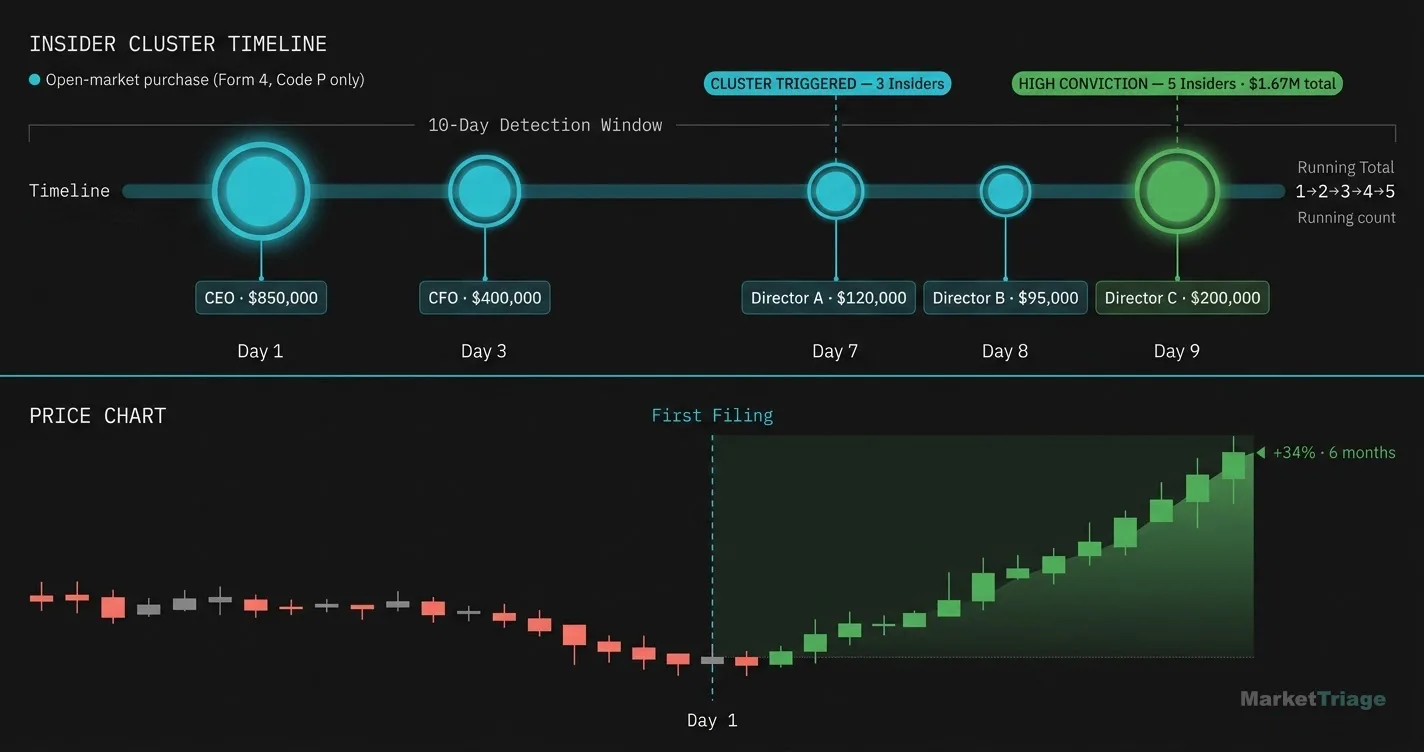
When five or more insiders meet these criteria, the system flags the cluster at high conviction — a rare event that has historically preceded significant price moves. In the MarketTriage conviction scoring system, a 3-4 insider cluster contributes 15-20 points toward the asset's total conviction score, while a 5+ insider cluster contributes 20-25 points.
Why a Single Insider Purchase Is Not a Reliable Signal
A single insider buying shares can occur for dozens of reasons unrelated to the company's prospects. Personal portfolio rebalancing, tax-loss harvesting offsets, contractual ownership requirements for new directors, and signaling confidence during a PR crisis all generate Form 4 filings with transaction code P. Without additional context, a lone filing is indistinguishable from noise.
Consider a real-world example: in Q3 2023, a newly appointed director at a mid-cap technology company purchased $50,000 in shares within their first week on the board. The filing generated headlines on retail-facing insider tracking websites. The purchase, however, was a contractual requirement of the director's appointment agreement — it carried zero informational value about the company's outlook. The stock declined 18% over the following quarter.
Contrast this with a true cluster event: in November 2022, five insiders at a regional bank — including the CEO, CFO, and three independent directors — purchased a combined $4.2 million in shares over eight days following a sector-wide selloff driven by rising interest rate fears. The purchases were unprompted by any contractual obligation and occurred at prices near the 52-week low. The stock recovered 34% within six months. The difference is not the existence of an insider purchase — it is the convergence of multiple independent actors making voluntary capital commitments at the same time.
A single vital sign reading in isolation — say, a slightly elevated temperature — rarely justifies a diagnosis. But when temperature, blood pressure, and white cell count all move in the same direction simultaneously, the convergence narrows the diagnostic possibilities dramatically. Cluster detection applies the same principle to insider filings.
Insider Cluster Buys: The 3-Insider Open-Market Pattern
An insider cluster buy is when 3 or more unique corporate insiders make open-market purchases of the same stock within a short window — typically 7 to 14 days. The pattern is more diagnostic than any single executive's purchase because it captures multiple independent actors (CEO, CFO, directors, 10%+ owners) committing personal capital at roughly the same price level. Cluster buys are tracked on dedicated feeds at OpenInsider, 13Radar, InsiderFinance, and 2iQ Research — the same data, surfaced at different thresholds.
How Different Services Define the Window
There is no SEC-defined window for a "cluster." Each tracker picks its own threshold, which materially changes how many tickers qualify on any given day:
MarketTriage's rationale for the 15-day acute window: insider buying — unlike selling — is discretionary and tends to compress in time. When executives decide the stock is undervalued, they typically act within days, not weeks. The 60-day backdrop layer catches sequential buying across two earnings cycles, weighted lower than the acute window in the conviction score.
Why the Cluster Pattern Has Held Up in Research
The empirical case for cluster buys rests on two foundational studies that are still routinely cited in 2026:
These figures are historical alpha measurements, not forward guarantees. Sample sizes are large but the studies pre-date the post-2010 explosion in algorithmic trading and 10b5-1 plan usage, both of which compress the public-information window. Treat the numbers as evidence the pattern has had statistical validity over multi-decade samples — not as a target return.
Cluster Buys in the Smart Money Stack
An insider cluster on its own is one signal. The conviction picture sharpens when the cluster aligns with quarterly 13F whale accumulation from institutional filers — Berkshire, Bridgewater, Pershing Square, Renaissance Technologies, and 11 others tracked by MarketTriage. When both insider buying (Form 4) and whale accumulation (13F) point the same way on the same ticker, the system awards a 25-point smart money bonus and triggers an automatic regime promotion. The full multi-signal framework — insider, whale, COT, technical, regime — is mapped on the Smart Money tracking hub.
How MarketTriage Automates Insider Signal Detection
MarketTriage's insider engine scans the SEC EDGAR Full-Text Search system daily, parsing Form 4 XML filings for every equity in its 366-asset monitoring universe. The engine extracts transaction codes, dollar values, reporting relationships, and filing dates, then applies the cluster detection algorithm described above. The entire pipeline runs autonomously — no manual review required.
From Filing to Dashboard: The Signal Pipeline
When the insider engine detects a cluster meeting all four criteria, the signal flows through a multi-stage pipeline:
Insider Signal Pipeline
- 01EDGAR Scan — Daily automated scan of SEC EDGAR for new Form 4 filings across all monitored equities.
- 02Filter — Transaction code P only. Awards, option exercises, and gifts are discarded. Each purchase must exceed $25,000.
- 03Cluster Detection — Rolling 15-day acute window (with a 60-day backdrop layer) groups purchases by ticker. Three or more unique insiders triggers a cluster signal.
- 04Conviction Scoring — Cluster size and dollar magnitude feed into the asset's total conviction score (15-25 points for insider signals).
- 05Confluence Check — The system checks for alignment with 13F whale accumulation, COT positioning, and technical structure. Insider + whale alignment awards a 25-point smart money bonus.
- 06Dashboard + Alerts — The cluster appears in the Insider Discovery Panel on the dashboard. High-conviction clusters trigger Telegram alerts to subscribed users.
The Smart Money Override
The most powerful signal in the MarketTriage conviction system is not any single data source — it is the alignment of independent smart money signals. When an insider buying cluster coincides with whale accumulation detected through 13F filings from major institutional investors, the system triggers a "smart money override" — an automatic regime promotion that bypasses normal scoring thresholds. This override awards 25 bonus conviction points and can elevate an asset directly to OBSERVATION status in the 6-state regime classification framework.
The rationale: when both corporate insiders (who know the company's internal operations) and institutional whales (who have dedicated research teams and billions in capital) independently arrive at the same conclusion — to accumulate — the convergence represents the strongest available evidence of undervaluation. It is the market equivalent of both the patient's own physician and an independent specialist recommending the same treatment.
How Insider Signals Feed Into Conviction Scoring
MarketTriage does not treat insider signals in isolation. Every insider cluster feeds into a multi-source conviction scoring system that combines insider data with COT institutional positioning, 13F whale holdings, technical price structure, and macro context. The conviction score determines an asset's regime classification and its position on the triage dashboard.
| Cluster Size | Signal Strength | Level | Interpretation |
|---|---|---|---|
| 1-2 insiders | No signal detected0 pts | None | Isolated purchases — may be routine or compensation-related. Insufficient evidence of coordinated conviction. |
| 3-4 insiders | Moderate signal15-20 pts | Moderate | Cluster detected. Three or more executives independently committing personal capital within the 15-day acute window. Historically associated with above-average 6-month returns. |
| 5+ insiders | Strong signal20-25 pts | High | Strong cluster. Five or more insiders buying open-market within 15 days, each above $25K. Rare event — historically precedes significant price appreciation in academic studies. |
| Insider + Whale | Strongest possible signal+25 bonus | Smart Money Override | Insider cluster aligns with 13F whale accumulation. The strongest conviction signal in the MarketTriage system — triggers automatic regime promotion. |
The conviction score is one input into MarketTriage's 6-state regime classification — a diagnostic framework that classifies every asset into one of six states: STABLE, CLEARANCE, OBSERVATION, ELEVATED, CRITICAL, or BREAKDOWN. A high-conviction insider cluster can be the signal that tips an asset from STABLE into CLEARANCE, or from CLEARANCE into OBSERVATION when combined with other bullish confluence factors.
Common Mistakes When Analyzing Insider Filings
Mistake 1: Treating All Form 4 Filings as Buy Signals
The majority of Form 4 filings are not open-market purchases. Option exercises (code M), stock awards (code A), and gifts (code G) generate Form 4 filings but carry no informational signal about the insider's confidence. Retail-facing websites that display all Form 4 activity without filtering by transaction code create a misleading picture. Only code-P open-market purchases represent a voluntary capital commitment.
Mistake 2: Ignoring Dollar Size
A director purchasing $5,000 in shares — the cost of a dinner for two at a conference — is not making a meaningful statement about the company's value. MarketTriage requires a minimum $25,000 threshold per individual transaction specifically to filter out ceremonial and de minimis purchases. The most informative insider signals involve six- and seven-figure commitments relative to the insider's existing holdings.
Mistake 3: Following Insider Sales as Bearish Signals
Insider selling is asymmetrically uninformative. Insiders sell for countless reasons: diversification, tax obligations, home purchases, divorce settlements, pre-planned 10b5-1 program liquidations. A CEO selling 5% of their holdings to buy a house tells observers nothing about the company's outlook. Insider buying, by contrast, has only one explanation — the insider believes the stock is undervalued. Research consistently finds that insider purchases predict returns more reliably than insider sales.
Mistake 4: Acting on a Single Filing Without Waiting for the Cluster
The statistical power of insider analysis comes from cluster detection — multiple independent actors converging on the same conclusion. A single code-P filing, even a large one, can be idiosyncratic. Waiting for the 15-day acute cluster window to close before drawing conclusions dramatically reduces the false positive rate. Patience is the edge.
Free Beta Access
Insider cluster alerts, regime signals, and institutional flow data — delivered to your inbox.
MarketTriage scans SEC EDGAR daily and detects insider buying clusters automatically. Join the triage room to receive smart money signals without manually parsing government filings.
- Pulse Check— Track actual institutional flow data, not Twitter hype.
- Sentiment Extremes— Know exactly when the market has reached peak “Hopium” or panic.
- Beta Status— Lifetime discount on future features
How to Look Up Form 4 Filings on SEC EDGAR
SEC EDGAR is the primary public database for all corporate filings, including Form 4 insider transaction reports. No registration or account is required — every filing is freely accessible. Here is a step-by-step process for looking up insider transactions for any publicly traded company.
Go to SEC EDGAR full-text search
Navigate to the SEC EDGAR filing search at efts.sec.gov/LATEST/search-index. This is the primary interface for searching all SEC filings by company or individual.
Enter company ticker or CIK number
Type the company ticker symbol (e.g., AAPL) or its Central Index Key (CIK) number in the search field. CIK numbers are unique identifiers the SEC assigns to every filing entity.
Select Form 4 as the filing type
Use the filing type filter and select "4" to narrow results to Form 4 filings only. This eliminates 10-Ks, 10-Qs, proxy statements, and other filing types from the results.
Open a filing and review key fields
Click on any filing to view the full document. Identify the reporting person, their relationship to the company (officer, director, 10% owner), the transaction date, and the number of shares involved.
Check the transaction code
The transaction code is the most important field. P = open-market purchase (voluntary capital commitment), S = sale, A = grant/award (compensation), M = option exercise. Only code P carries genuine informational value.
Filter signal from noise
Focus on open-market purchases (code P) where the total transaction value exceeds $25,000. Small purchases, option exercises, and stock awards are routine corporate activity and do not indicate insider conviction.
For detailed instructions on reading Form 4 fields, see the SEC's official Form 4 instructions page. MarketTriage automates this entire process — scanning EDGAR daily, filtering for code-P transactions, and detecting clusters across all 366 monitored equities.
Insider Trading Trackers Compared
Several tools provide access to SEC Form 4 insider filing data. They differ in scope, automation, and whether they combine insider signals with other institutional data sources. The table below compares the most widely used insider tracking platforms.
| Tool | Focus | Free | Cluster Detection | Multi-Signal |
|---|---|---|---|---|
| OpenInsider | Insider filings, all filers | Yes | No | No |
| secform4.com | Form 4 data + alerts | Yes | No | No |
| InsiderFinance | Insider + options flow | Partial | Basic | No |
| Finviz | Screener + insider tab | Yes | No | No |
| SEC EDGAR | Raw filings (primary source) | Yes | No | No |
| MarketTriage | 15 insider metrics + signals | Yes (beta) | Yes (3+ insiders, adaptive $) | Yes (insider + whale + COT + regime) |
Most insider tracking tools display raw Form 4 data without filtering by transaction code or applying cluster detection logic. MarketTriage is the only platform that combines insider cluster detection with 13F whale holdings, COT institutional positioning, and regime classification into a unified conviction scoring system.
Frequently Asked Questions
What is the difference between insider trading and insider buying signals?
Illegal insider trading involves buying or selling based on material non-public information. Insider buying signals refer to legal, disclosed purchases by corporate officers filed with the SEC on Form 4 within 2 business days. Every transaction discussed in this context is a publicly reported, fully legal filing.
How quickly are SEC Form 4 filings made public?
The SEC requires Form 4 to be filed within 2 business days of a transaction. Filings appear on the SEC EDGAR database immediately upon acceptance — typically the same day they are submitted. MarketTriage scans EDGAR daily to detect new filings.
What is an insider buying cluster?
An insider buying cluster occurs when 3 or more unique corporate insiders purchase open-market shares of the same company within a short window — typically 10 days. Clusters are considered more significant than single insider purchases because multiple executives independently committing personal capital suggests broad internal confidence.
Do insider buying signals work for all stocks?
Insider signals work best for mid-cap and large-cap equities where executives have deep operational knowledge. For micro-caps, small dollar amounts and thin liquidity make the signal unreliable. Academic research finds the strongest predictive value above $500 million in market cap.
How does MarketTriage combine insider signals with other data?
MarketTriage feeds insider cluster detections into a multi-signal conviction scoring system alongside COT positioning, 13F whale holdings, technical structure, and macro context. When insider buying aligns with whale accumulation from 13F filings, the system awards a 25-point smart money bonus — the highest confluence score available.
Is it legal to trade based on SEC Form 4 data?
Yes. Form 4 filings are public disclosures of legal transactions. Trading based on published Form 4 data is entirely legal. What is illegal is trading on material non-public information before it is disclosed. Once a Form 4 is filed on EDGAR, anyone can use that information.
What is the difference between SEC Forms 3, 4, and 5?
Form 3 is the initial ownership statement filed when someone becomes an insider. Form 4 reports changes in ownership within 2 business days. Form 5 is an annual summary of transactions that were not required to be reported on Form 4, such as small gifts.
How do you filter 10b5-1 plan sales from meaningful insider trades?
10b5-1 plans are pre-scheduled selling programs that execute automatically. They appear on Form 4 but carry no directional signal. MarketTriage focuses on open-market purchases (transaction code P), which represent discretionary capital commitment and are not part of automated plans.
What percentage of insider buys are historically profitable?
Academic research by Lakonishok and Lee (Review of Financial Studies, 2001) found that firms with heavy insider buying outperformed firms with heavy insider selling by roughly 7.8% over the following 12 months — about 4.8% after adjusting for size and value — with the effect concentrated in smaller-cap names. Clusters of multiple insiders buying tend to be stronger signals than isolated purchases.
What is an insider cluster buy?
An insider cluster buy is when 3+ corporate insiders independently make open-market purchases (Form 4 code P) of the same stock within a short window — MarketTriage uses a 15-day acute window with a 60-day backdrop. Multiple executives committing personal capital at the same price level signals stronger conviction than any single purchase.
What does Form 4 transaction code P mean?
Form 4 transaction code P = open-market purchase: the insider spent personal money at the prevailing price. Strongest bullish signal among Form 4 codes. Code A = compensation award (no signal), code M = option exercise (mechanical), code S = open-market sale (informational). Only code P transactions count toward MarketTriage cluster detection.
How fast must a Form 4 be filed?
Section 16(a) of the Securities Exchange Act of 1934 requires Form 4 to be filed within 2 business days of the transaction. Filings appear on SEC EDGAR the same day they are accepted. MarketTriage scans the EDGAR EFTS feed daily, so most clusters surface within 24 to 48 hours of the underlying purchase.
Continue Learning
Live Insider Tracker
Live SEC Form 4 cluster feed — $500k+ purchases, C-suite filter, 5+ insider convergence
live data readPosition Trading System
How to synthesise COT, 13F, Form 4, and regime signals into a multi-month thesis
14 min readCOT Report Explained
How institutional futures positioning signals turning points
15 min read13F Filings Explained
Track what the biggest funds are buying and selling
12 min readMarket Regime Classification
Six structural states that replace simple buy/sell signals
18 min readBest Brokers for Active Traders
Best brokers for acting on insider-cluster signals — fees, execution quality and regulation compared
15 min readSee MarketTriage Plans →
For informational purposes only. Historical patterns are not indicative of future results. This is not financial advice. MarketTriage provides observational analysis of publicly available regulatory data and does not offer directional trade recommendations. SEC filings data: SEC EDGAR. Academic references: Lakonishok & Lee (2001, Review of Financial Studies); Cohen, Malloy & Pomorski (2012, Journal of Finance).